

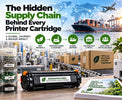
The Hidden Supply Chain Behind Every Printer Cartridge
, by Planet Green, 5 min reading time
, by Planet Green, 5 min reading time
A printer cartridge may seem like a simple office supply.
It is purchased, installed, used, replaced, and often forgotten.
But behind every cartridge is a supply chain involving materials, manufacturing, transportation, packaging, warehousing, distribution, and end-of-life handling. Understanding that supply chain helps explain why printer cartridge purchasing decisions affect more than office supply budgets.
They also affect waste, domestic manufacturing, and resource use.
Every new cartridge begins with materials.
Plastics must be produced. Metals must be formed. Electronic parts must be manufactured. Packaging must be printed and assembled. Components must be shipped to factories, assembled into finished cartridges, boxed, transported to distributors, warehoused, and finally delivered to customers.
By the time a cartridge reaches a business, school, or public agency, it has already passed through a long chain of resource use and labor.
That is why discarding a cartridge after one use can represent more than the loss of plastic.
It represents the loss of the manufacturing value already invested in the product.
Many replacement printer cartridges are manufactured overseas and imported into the United States.
That does not automatically mean they are defective or poor quality. It does mean the product may depend on long-distance transportation, international manufacturing networks, customs processes, ocean freight, domestic trucking, and multi-step distribution.
Recent years have reminded businesses that supply chains can be disrupted by transportation delays, material shortages, labor shortages, geopolitical events, and shifting trade conditions.
The National Institute of Standards and Technology has identified supply chain resilience as an important issue for manufacturers, especially small and medium-sized manufacturers navigating disruptions and supplier risk. (cite: National Institute of Standards and Technology, Building Resilient Supply Chains)
Remanufacturing changes the supply chain.
Instead of relying only on newly manufactured cartridges, domestic remanufacturers recover empty OEM cartridges already in circulation, inspect them, rebuild qualifying cartridges, and return them to use.
This creates a supply chain based partly on recovery rather than replacement.
The raw material is not only newly manufactured plastic or metal.
The raw material is also the empty OEM cartridge collected from businesses, schools, organizations, and consumers.
That makes cartridge collection an important part of the remanufacturing supply chain.
In the remanufacturing industry, an empty OEM cartridge is often referred to as a core.
A usable core has value because it can potentially be rebuilt.
Without a steady supply of empty OEM cores, remanufacturing becomes more difficult. That is why recycling programs matter. They are not just disposal programs. They are collection systems that help supply domestic remanufacturing.
Every cartridge returned through a proper collection program creates the possibility of another product life cycle.
OEM surplus follows a different path but supports a similar principle: use what already exists.
A genuine OEM surplus cartridge is new and unused, but it enters the market through excess inventory, overstock, liquidation, packaging changes, warehouse consolidation, or other secondary distribution channels.
Using OEM surplus inventory helps ensure products that have already been manufactured reach customers instead of sitting unused, becoming obsolete, or being wasted.
This fits within the broader logic of Sustainable Materials Management, which encourages more efficient use of materials across their life cycle. (cite: U.S. Environmental Protection Agency, Sustainable Materials Management)
Most buyers focus on price and compatibility.
Those are important.
But supply chain should also matter.
A cartridge purchase can support a long-distance disposable replacement model, or it can support a system that recovers existing OEM products, remanufactures them domestically, and keeps materials in use longer.
For organizations with sustainability goals, supplier diversity goals, domestic purchasing preferences, or cost-control priorities, understanding the cartridge supply chain can lead to better purchasing decisions.
Newly manufactured compatible cartridges are often built as replacement products by third-party manufacturers.
Some may perform adequately. Others may vary widely in construction, components, quality control, or long-term reuse potential.
The key supply chain distinction is that a compatible cartridge is usually a newly manufactured alternative, while a remanufactured cartridge begins with an original OEM cartridge that has already completed one service cycle.
That distinction affects reuse, collection value, and the future availability of remanufacturable cores.
A healthier cartridge market does not rely on only one supply path.
Businesses benefit when they have multiple options:
Each option serves a different role.
But remanufacturing and surplus inventory both help reduce dependence on constantly manufacturing and importing newly made replacement products.
The cartridge supply chain does not have to end when the cartridge is empty.
Since 1999, Planet Green Recycle has operated within this recovery-based supply chain by collecting empty OEM cartridges, remanufacturing qualifying cartridges in the United States, recycling materials when appropriate, and offering genuine OEM surplus inventory.
A printer cartridge is not just a consumable.
It is part of a larger system.
The question is whether that system ends in disposal or continues through reuse.
Sources
National Institute of Standards and Technology
Building Resilient Supply Chains: Strategies and Successes
https://www.nist.gov/blogs/manufacturing-innovation-blog/building-resilient-supply-chains-strategies-and-successes
U.S. Environmental Protection Agency
Sustainable Materials Management
https://www.epa.gov/smm
Ellen MacArthur Foundation
Circulate Products and Materials
https://www.ellenmacarthurfoundation.org/circulate-products-and-materials

Many churches and church groups benefit from fundraising for all kinds of important work. Youth programs, mission projects, community outreach, food ministries, special events and...

School fundraising usually comes with a catch. Someone has to sell something. Parents are asked to buy something. Students bring order forms home. Teachers and...

“Made in the USA” is a powerful phrase. For many buyers, it suggests domestic manufacturing, American jobs, shorter supply chains, and confidence in how a...

A printer cartridge may seem like a simple office supply. It is purchased, installed, used, replaced, and often forgotten. But behind every cartridge is a...