

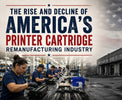
The Rise and Decline of America's Printer Cartridge Remanufacturing Industry
, by Planet Green, 5 min reading time
, by Planet Green, 5 min reading time
For many years, the United States was home to a thriving printer cartridge remanufacturing industry.
Thousands of companies collected empty printer cartridges, rebuilt them using original OEM cartridge bodies, and returned them to businesses, schools, government agencies, and consumers. The industry created manufacturing jobs, reduced landfill waste, and offered customers an affordable alternative to purchasing new printer cartridges.
Today, that landscape looks very different.
While remanufacturing continues to play an important role in sustainable manufacturing, the number of American companies engaged in large-scale cartridge remanufacturing has declined dramatically over the past two decades.
Understanding why that happened helps explain why remanufactured cartridges remain important today.
During the rapid expansion of inkjet and laser printing throughout the 1990s and early 2000s, millions of original OEM printer cartridges entered the marketplace every year.
Unlike many disposable products, OEM cartridges were engineered with durable housings and precision components that often made them suitable for rebuilding after their initial use.
Entrepreneurs across the country recognized an opportunity.
Companies began collecting empty OEM cartridges, replacing worn components, refilling them with new ink or toner, testing their performance, and selling them as professionally remanufactured products.
By the early 2000s, cartridge remanufacturing had become a significant American manufacturing sector.
Industry estimates suggested that between 2,000 and 3,000 independent remanufacturing companies operated throughout the United States during the industry's peak. These ranged from small regional businesses to large manufacturers supplying distributors, retailers, office supply dealers, and government agencies. (cite: Industry estimates reported by trade publications including Recharger Magazine and historical reporting from the International Imaging Technology Council (I-ITC))
Entire businesses developed around cartridge collection, logistics, component manufacturing, quality testing, packaging, and recycling.
Communities benefited from manufacturing jobs that could not easily be outsourced because the raw material - the empty OEM cartridge - was generated domestically.
As the industry matured, remanufacturing became increasingly sophisticated.
Manufacturers invested in:
Professional remanufacturers worked to produce products capable of delivering reliable performance while extending the useful life of original OEM cartridges.
The industry evolved far beyond simply refilling empty cartridges.
Beginning in the mid-2000s, the marketplace began changing.
Large volumes of newly manufactured third-party compatible cartridges entered the United States from overseas manufacturers.
Unlike remanufactured cartridges, these products were manufactured as entirely new cartridges rather than rebuilt from original OEM products.
Many compatible cartridges competed primarily on purchase price.
As import volumes increased, domestic remanufacturers faced growing price competition from products manufactured in countries with different labor costs, production expenses, and supply chains.
The result was increasing pressure on American manufacturers.
Another challenge emerged.
Successful remanufacturing depends upon recovering empty OEM cartridges.
When businesses recycle or return used cartridges, those original products can potentially be rebuilt.
When cartridges are discarded—or replaced by newly manufactured compatibles that cannot always be economically remanufactured—the supply of reusable OEM cores declines.
Over time, recovering sufficient quantities of reusable cartridges became more difficult for many remanufacturers.
As market conditions changed, many companies left the industry.
Some merged.
Others shifted toward distribution rather than manufacturing.
Many closed entirely.
While comprehensive national statistics are not available, industry organizations and long-time participants generally agree that only a small fraction of the companies operating during the industry's peak remain engaged in large-scale U.S. cartridge remanufacturing today. (cite: International Imaging Technology Council; historical industry reporting; industry participant observations)
The industry's decline represents not only the loss of manufacturing businesses, but also the loss of technical expertise developed over decades.
Despite these changes, the principles that made cartridge remanufacturing successful remain the same.
Every OEM cartridge that can be professionally rebuilt represents:
The U.S. Environmental Protection Agency identifies reuse and product life extension as important components of Sustainable Materials Management because they reduce demand for new materials while minimizing waste. (cite: U.S. Environmental Protection Agency, Sustainable Materials Management)
The printer cartridge industry continues to evolve.
Businesses increasingly evaluate suppliers based not only on price, but also on product quality, sustainability, supply chain reliability, and environmental responsibility.
Professional remanufacturing remains one of the few manufacturing processes that combines all of these objectives by extending product life while reducing waste.
Although the industry is smaller than it once was, its role in supporting resource conservation and domestic manufacturing remains significant.
Founded in 1999, Planet Green Recycle entered the industry during one of the most active periods in American cartridge remanufacturing.
Over the past quarter century, the company has witnessed the industry's expansion, technological advancement, changing market conditions, and continuing evolution.
Today, Planet Green continues collecting empty OEM cartridges, manufacturing remanufactured ink cartridges in the United States, and offering genuine OEM surplus products that help businesses reduce costs while supporting more sustainable printing practices.
As fewer domestic remanufacturers remain, preserving the knowledge, infrastructure, and manufacturing capabilities developed over decades becomes increasingly important—not only for the printing industry, but for the broader goals of resource conservation and American manufacturing.
Sources
U.S. Environmental Protection Agency
Sustainable Materials Management
https://www.epa.gov/smm
International Imaging Technology Council (I-ITC)
Industry resources and market information.
https://i-itc.org
Recycle.Emory.edu – Printer cartridge recycling overview.
https://recycle.emory.edu

Many churches and church groups benefit from fundraising for all kinds of important work. Youth programs, mission projects, community outreach, food ministries, special events and...

School fundraising usually comes with a catch. Someone has to sell something. Parents are asked to buy something. Students bring order forms home. Teachers and...

“Made in the USA” is a powerful phrase. For many buyers, it suggests domestic manufacturing, American jobs, shorter supply chains, and confidence in how a...

A printer cartridge may seem like a simple office supply. It is purchased, installed, used, replaced, and often forgotten. But behind every cartridge is a...