

Why Some Printer Cartridges Can Be Remanufactured And Others Cannot
, by Planet Green, 2 min reading time
, by Planet Green, 2 min reading time
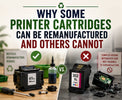
Not every empty printer cartridge can become a remanufactured cartridge.
That surprises many consumers.
If two cartridges fit the same printer, why can one often be rebuilt while another cannot?
The answer lies in how the cartridge was originally designed and manufactured.
Some cartridges were engineered by the original equipment manufacturer (OEM) using durable housings intended to meet strict performance standards. Others are newly manufactured third-party compatible cartridges designed primarily as replacement products. Although both may perform the same printing function, their construction and long-term reuse potential can differ significantly.
Understanding those differences helps explain why original OEM cartridges remain the foundation of the remanufacturing industry.
An OEM cartridge is engineered by the company that designed the printer.
Manufacturers develop cartridges with precise mechanical tolerances, fluid pathways, electronic interfaces, and structural components intended to work together throughout the cartridge's service life.
Because these cartridge bodies are manufactured to consistent specifications, many can be professionally rebuilt after their initial use.
Remanufacturing depends upon that consistency.
When remanufacturers collect empty OEM cartridges, they begin with a known product.
They understand:
This consistency allows technicians to inspect, repair where appropriate, refill, test, and verify performance before returning the cartridge to service.
Compatible cartridges are newly manufactured products designed by companies other than the original printer manufacturer.
Construction methods vary widely among manufacturers.
Some compatible cartridges perform well.
Others are designed primarily to reduce manufacturing costs.
Because compatible cartridge designs are not standardized, recovering and rebuilding them is often more complicated than remanufacturing original OEM products.
Each manufacturer may use different plastics, internal structures, electronic components, or assembly methods.
This variability makes large-scale remanufacturing considerably more difficult.
Even original OEM cartridges cannot always be remanufactured.
A cartridge may be unsuitable if it has:
Professional inspection determines whether rebuilding remains practical.
Many cartridge collection programs specifically request original OEM cartridges.
The reason is straightforward.
OEM cartridges generally provide the most consistent foundation for successful remanufacturing.
Recovering these cartridges helps preserve a supply of reusable products while reducing unnecessary manufacturing of entirely new replacements.
The U.S. Environmental Protection Agency encourages extending product life whenever practical as part of Sustainable Materials Management.
When an OEM cartridge can be professionally remanufactured, the useful life of that product continues rather than ending after a single service cycle. (cite: U.S. Environmental Protection Agency, Sustainable Materials Management)
This approach helps conserve materials while supporting domestic remanufacturing and reducing unnecessary waste.
Sources
U.S. Environmental Protection Agency
Sustainable Materials Management
https://www.epa.gov/smm
Rochester Institute of Technology
Center for Remanufacturing and Resource Recovery
https://www.rit.edu/sustainabilityinstitute/center-remanufacturing-and-resource-recovery

“Made in the USA” is a powerful phrase. For many buyers, it suggests domestic manufacturing, American jobs, shorter supply chains, and confidence in how a...

A printer cartridge may seem like a simple office supply. It is purchased, installed, used, replaced, and often forgotten. But behind every cartridge is a...

Recycling is important, but it is not always the highest-value environmental outcome. For many products, the better question is not simply, “Can this be recycled?”...

Not every empty printer cartridge can become a remanufactured cartridge. That surprises many consumers. If two cartridges fit the same printer, why can one often...